
Reimagining Urban Spaces Through Human-Centered Design
Applying Stanford Design Thinking to create a more inclusive playground experience for children, parents, and communities.
My Role
UX Designer — research, ideation, prototyping, storytelling, iteration.
Scope
Surveys, informal interviews, literature review, SCAMPER, 7Cs framework, rapid brainstorming.
Tools
Stanford Design Thinking methodology, Figma, Google Survey, IDEO-based ideation frameworks.
Outcome
An Honours project with instructor commendation.
TL;DR — Most city playgrounds solve the wrong problem. They are safe, compliant, and completely uninspiring. This honours-level project applied the full Stanford Design Thinking process to reimagine a Toronto playground from the ground up, grounded in real research with children and parents. The project received instructor commendation and was recognized as an outstanding application of human-centered design methodology.
Stanford Design Thinking Methodology

Empathize

Define
Ideate
Prototype

Test / Iterate
The Opportunity
Canadian playgrounds are losing relevance, and children are voting with their feet by staying inside. The design problem wasn’t safety or compliance; it was that children aged 5-12 had been given spaces built for liability management, not imagination, connection, or joy.
Whether it’s a playground, an onboarding flow, or a landing page, the same mistake repeats: designing for the system instead of the person.

Standardized playground designs meet safety requirements but fail to engage children emotionally or creatively.
Research
and Discovery
Before sketching or ideating, I needed a grounded understanding of how children and parents actually experience playgrounds. I began with first‑hand research to capture real needs, frustrations, and emotional patterns, then synthesized the findings through empathy mapping.
- In-person interviews with children and parents
- Surveys distributed through community channels
- Field observation of local playgrounds
- Secondary research on child development, outdoor play, and public health
Research findings were synthesized into two primary archetypes representing the needs of both the child and the caregiver. Together, they became the lens through which every design decision was evaluated.
“I want a castle I can climb on and explore inside.” — Olivia, age 7
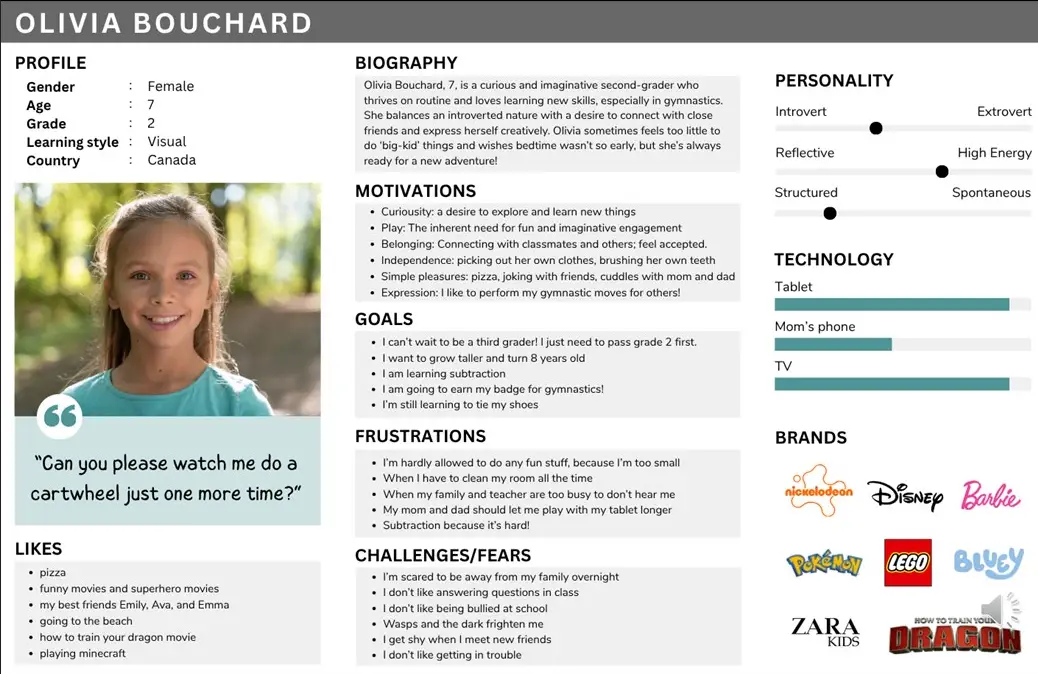
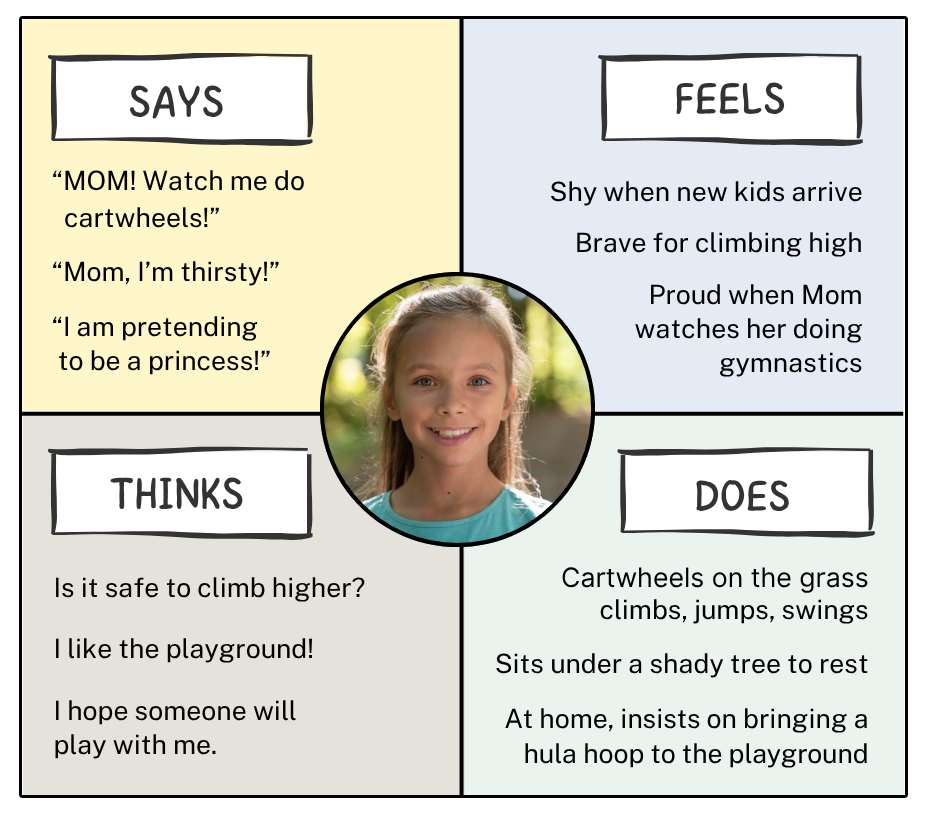
Olivia Bouchard: a curious Grade 2 student who loves gymnastics, pizza, and imaginative play.
“I need an clear view of my daughter at all times.” — Jennifer, age 37
Jennifer Bouchard: seeking more independence for her child and more hours in the day to balance work, health, and home.
User Insights
Four themes emerged across all research methods:
Children stay longer and play more creatively when environments spark storytelling and role play.
Parents need unobstructed sightlines. Children need freedom within safe boundaries. These are not opposing needs, they can be designed for simultaneously.
Sensory variation, multiple access points, and flexible zones support children with diverse physical and cognitive needs.
Play spaces feel more meaningful when they reflect local culture and landmarks. Children engage more deeply with environments they can claim as their own.
Reframing the Problem
Children aged 5 to 12 in Canadian urban areas need engaging, inclusive playgrounds that spark joy, connection, and imagination through unstructured outdoor play. Uninspiring designs and limited parental time are driving children indoors — hindering physical health, social skills, and creative development.
Strategy
Using the 7Cs outdoor play framework, I identified seven principles that shaped the spatial and conceptual design:
- Context: grounding the design in Toronto’s identity
- Clarity: intuitive zoning and sightlines
- Challenge: age‑appropriate physical exploration
- Connectivity: shared spaces for families
- Change: varied sensory and activity zones
- Chance: open‑ended, unstructured play
- Character: imaginative, themed structures
I used a full ideation toolkit including SCAMPER, Crazy 8s, Role Storming and Rapid Sketching to push beyond predictable solutions and surface the patterns that shaped the final design.
Ideation
With the problem clearly defined, the goal was to diverge before converging, generating as many directions as possible before filtering for what was feasible, inclusive, and genuinely compelling.

Unfiltered, uncensored brainstorming from a child’s perspective—no editing, no self-censoring. Clear patterns emerged quickly around imaginative role-play, physical freedom, social connection, and sensory exploration.
➤ Forts, safaris, water play
➤ Shade, seating, quiet nooks
➤ Places to storytell, perform, skip rope

Rather than asking what a playground should have, SCAMPER asked what could be interrogated, flipped, or reimagined.
➤ Substitute concrete and steel for natural, sensory‑rich materials.
➤ Combine water play and sand into one sensory zone.
➤ Adapt monkey bars for multiple ability levels.
➤ Redesign the seesaw for solo or uneven use.

Using the 7Cs framework, constraints were reframed as opportunities, each question pointing directly to a design decision.
“How might we connect to the neighbourhood?”
➤ Toronto landmark theming
“What if kids could leave their mark?”
➤ Chalk walls, sculpture zones
“How might sightlines serve both parents and children?”
➤ Open layout strategy

Exploring the space through multiple user perspectives surfaced needs a single-user lens would have missed; many became non-negotiable design requirements.
➤ Shy child
quiet zones, low-pressure entry points
➤ Child with sensory differences
texture, sound, scent variation
➤ Grandparent with toddler
seating, shade, accessibility
Design Decisions
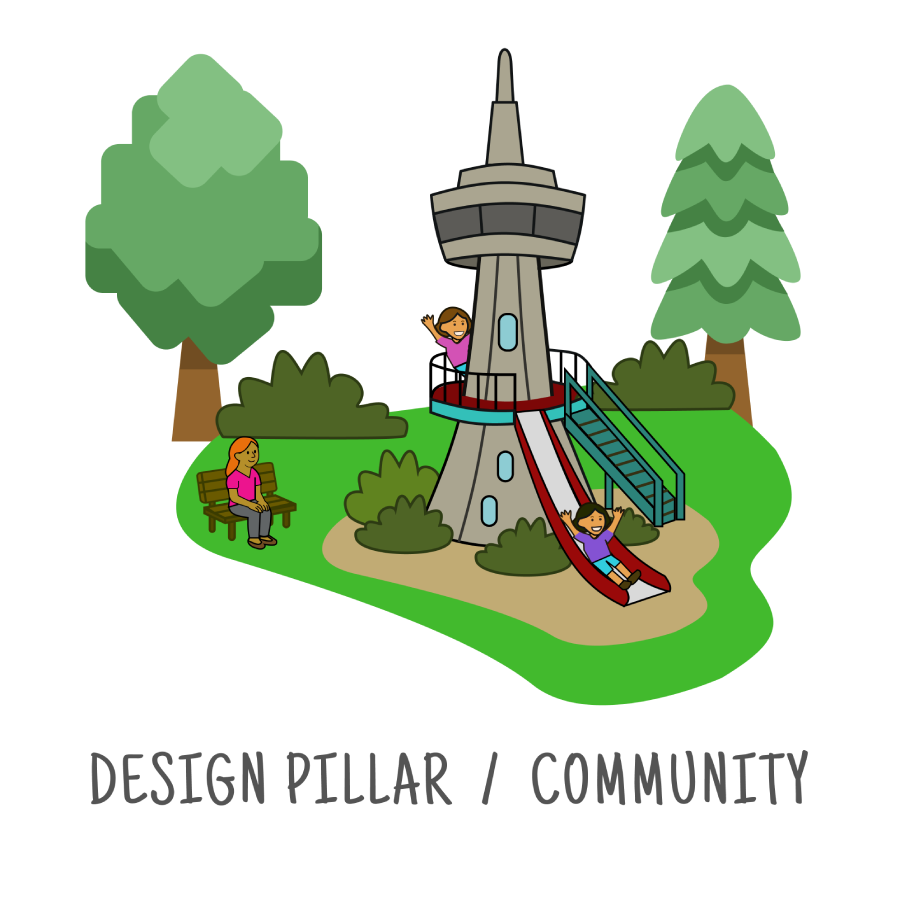
Community/Toronto-themed play zones
Landmarks including the CN Tower, Casa Loma, Centre Island, and Edward Gardens create a sense of place and spark imaginative play. The design becomes a map of the city children can explore on their own terms.
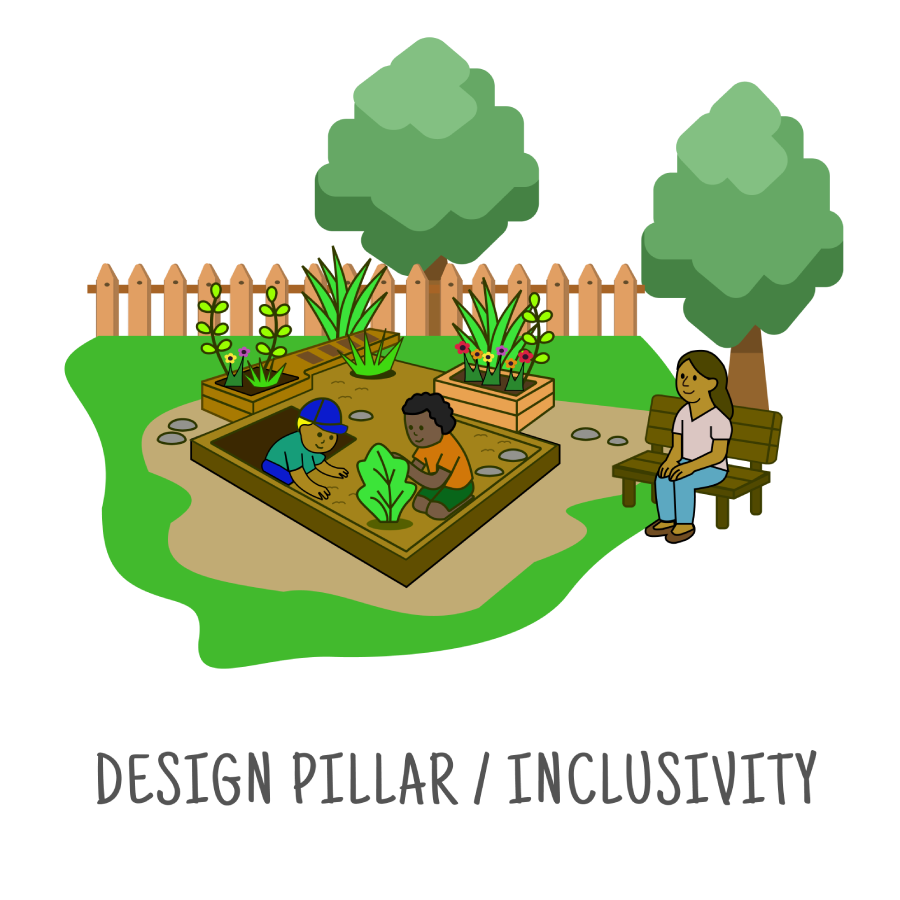
Inclusive,
multi-sensory play
Natural textures, raised garden beds, and varied surfaces support sensory exploration for children with diverse needs. Accessibility is designed in from the beginning, not retrofitted.
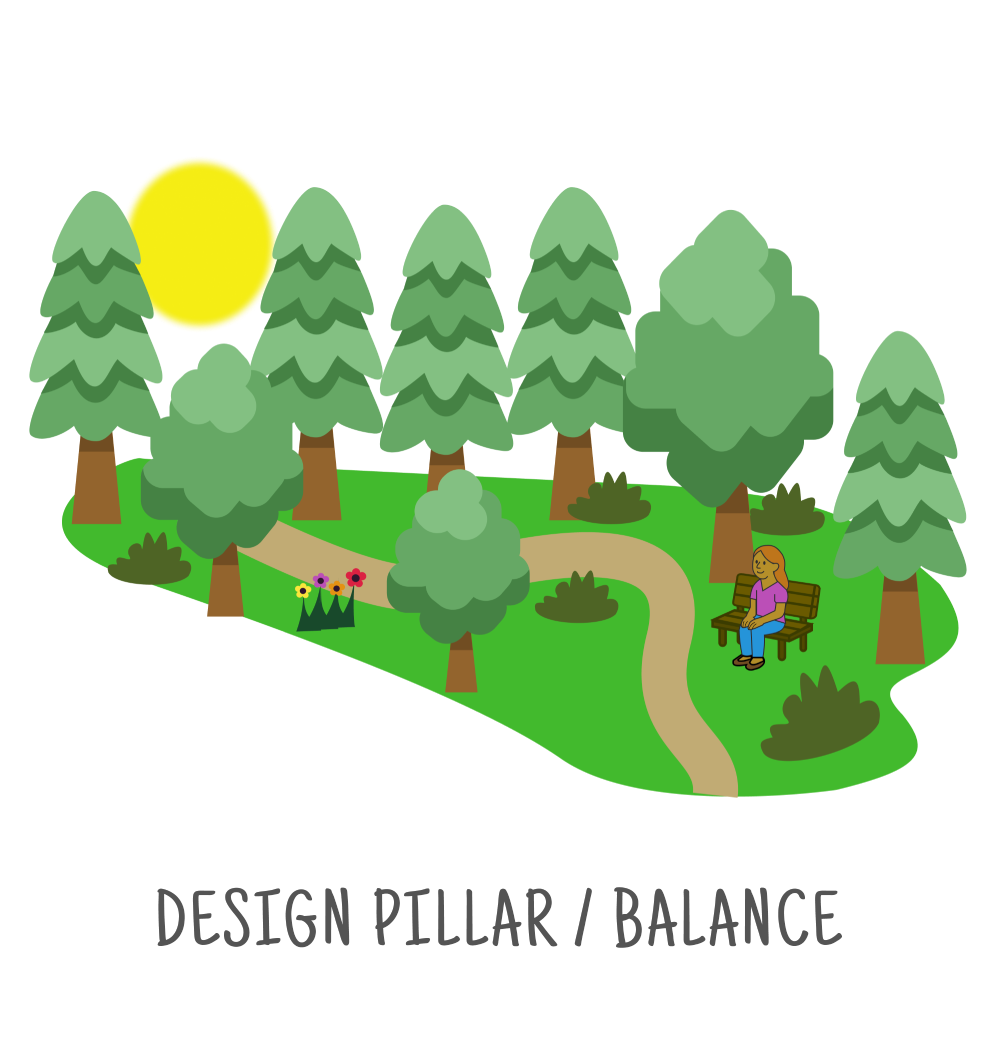
Flexible Zones
Quiet zones for reading, sensory play, and rest. Active zones for gymnastics, climbing, and running. Shared zones for families and community interaction. The design supports every kind of child, not just the most active one.
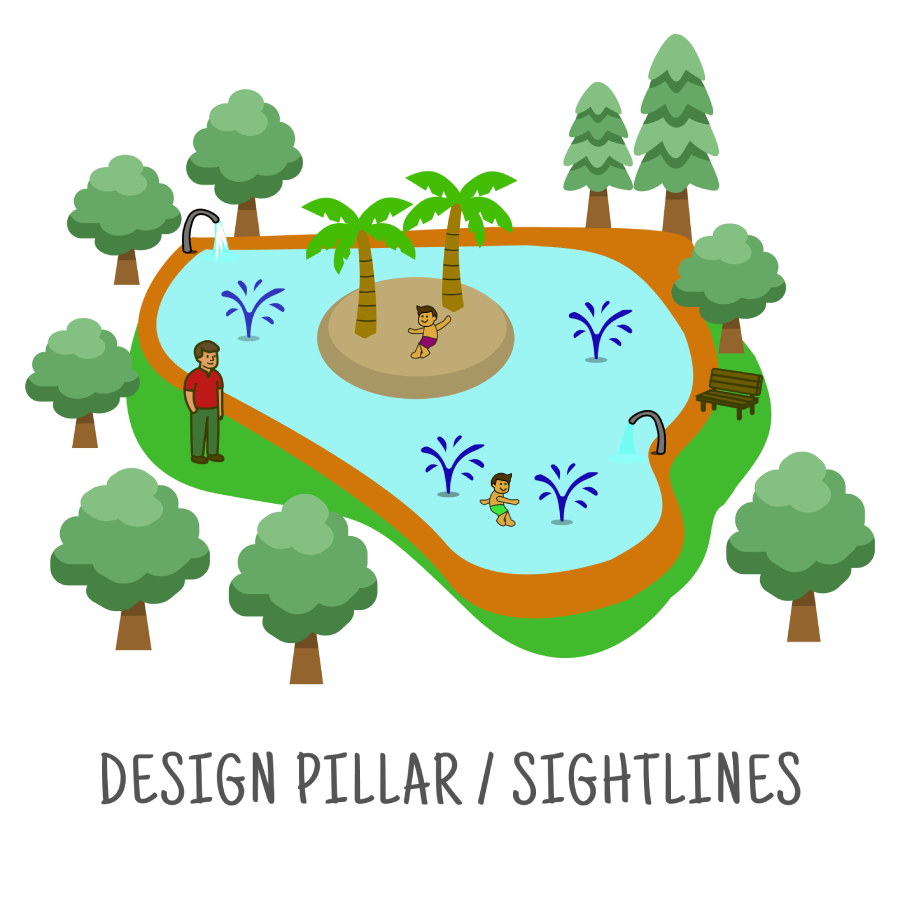
Sightlines
Elevated decks, low barriers, and open pathways allow parents to supervise without hovering. Children experience freedom; parents experience confidence. The spatial layout resolves both needs without compromise.
Prototyping and Iteration
The design evolved through low-fidelity sketches to test zoning and sightlines, concept refinement based on user feedback, and a full Figma prototype integrating all research insights into a cohesive environment. Targeted refinements followed: adding onsite bathroom facilities to support longer family visits, adjusting circulation paths for accessibility and wayfinding, and clarifying shared spaces for community use.
Human‑centered
low-fidelity prototyping
in urban spaces
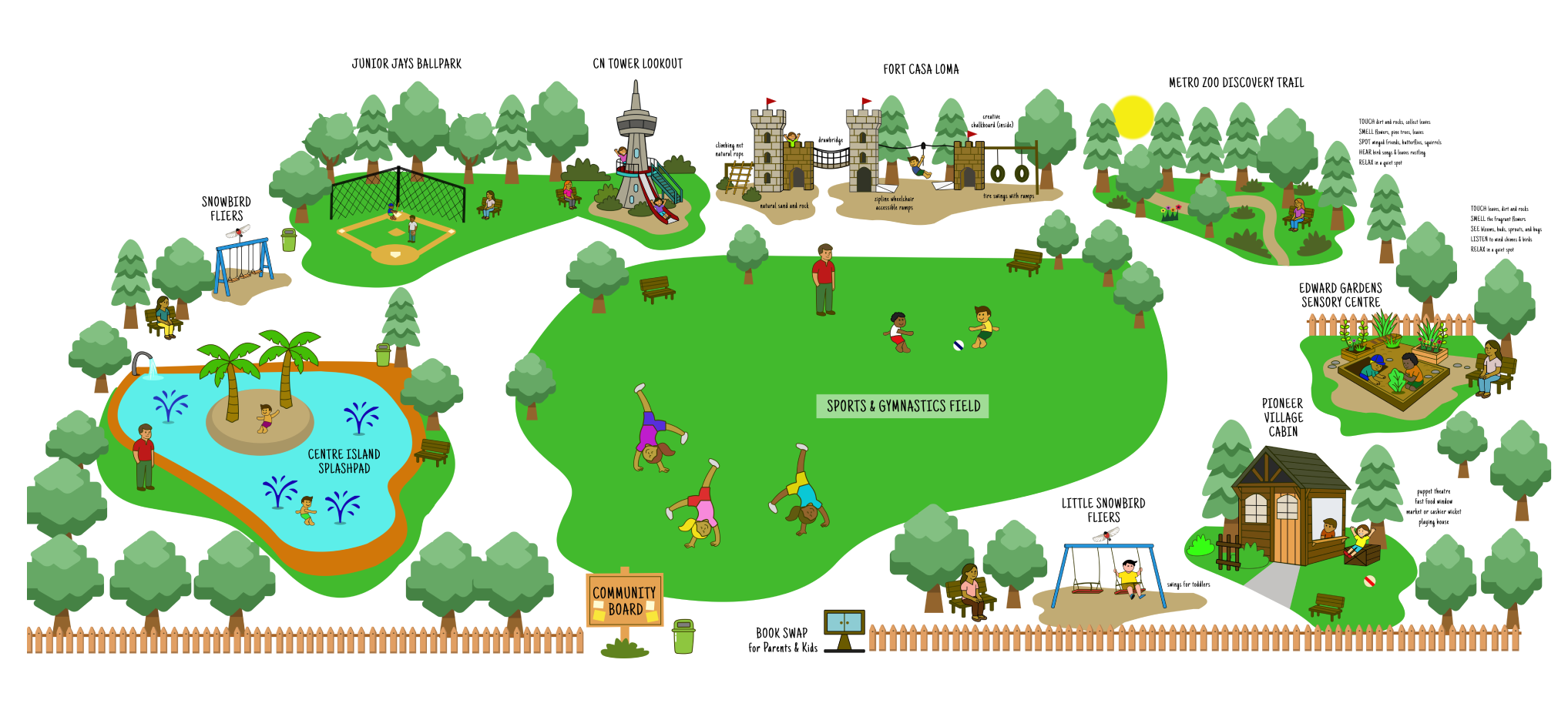
Refinements informed by feedback: onsite bathrooms, circulation clarity, family amenities.
Outcome and Impact
The project culminated in a fully interactive prototype supported by user research, iterative testing, and the complete Stanford Design Thinking Methodology process.
It received instructor commendation for its application of human-centered design methodology and demonstrated how inclusive physical environments can be strengthened through complementary digital experiences.
Instructor Feedback
“Leslie, your project on reimagining urban playgrounds as inclusive, imaginative spaces was exceptional. You deeply applied the Design Thinking process, supported by strong empathy work, layered ideation, and a thoughtful prototype brought to life with clear storytelling.
“The use of tools like empathy mapping and SCAMPER, along with your real-world references and reflection, showed advanced thinking and care. This was not only a polished presentation, it was a compelling case for human-centered design in public spaces. Outstanding work.“
— Course Instructor, Stanford Design Thinking Methodology, McMaster University
What I Learned
This project reshaped how I approach design. It reinforced that meaningful experiences emerge when empathy, structure, and practical constraints are considered together, whether designing a playground, a brand system, or a digital interface.
It also deepened my understanding of how psychological barriers shape user behaviour. Fear of failure, self-doubt, and uncertainty are not just UX problems on digital screens; they affect whether a parent feels confident letting their child play independently, whether a child feels welcome in a space, and whether a community claims it as its own.
Designing with accessibility as a baseline strengthened the solution for every user. A playground that works for a child with sensory processing differences also works better for every other child.
That mindset now shapes how I approach every project.
Beyond the Playground
Research identified opportunities to extend the playground experience beyond the physical environment.
As a future iteration, I developed a working mobile companion prototype that provides wayfinding, accessibility information, community updates, events, and real‑time park activity insights, illustrating how the digital layer could meaningfully support the onsite experience.
While beyond the original project scope, this prototype demonstrates how the broader service ecosystem could evolve to support ongoing engagement and inclusivity.
Use the navigation to explore each screen, and try the check‑in feature to see how real‑time activity updates would work.
Let’s Build Something
That Matters
If you’re building thoughtful systems, digital or physical, I’d love to hear from you.